
Recently, I’ve noticed a recurring theme among business owners as January rolls around: a distinct sense of panic regarding their filings. In reality, tax season doesn’t have to be a chaotic fire drill if you have the right systems in place. For instance, many entrepreneurs scramble to find receipts from March or guess at the purpose of a withdrawal from June, hoping their mental notes are enough. However, relying on memory or scattered files is the fastest way to overpay your taxes or trigger an audit. Because a proactive approach saves you money, time, and sanity, we have built a comprehensive tax season checklist to get you ready. Therefore, utilizing a structured tax season checklist is the only way to ensure your filing is accurate, optimized, and stress-free.

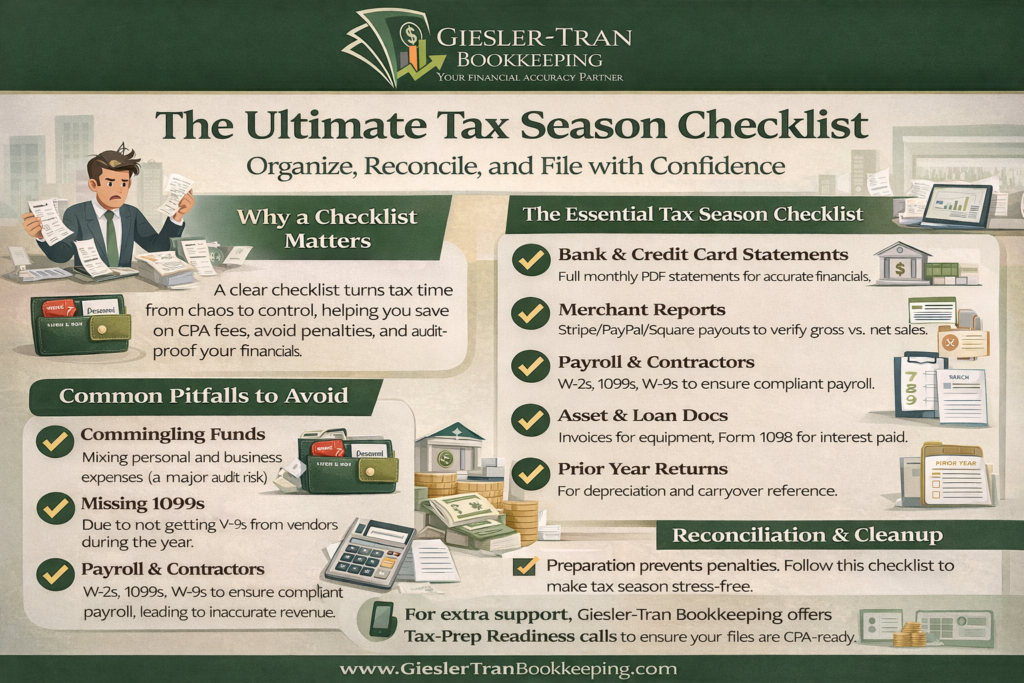
The Ultimate Tax Season Checklist: Organize, Reconcile, and File with Confidence
Preparation prevents penalties.
The Reality Check: Fundamentally, good bookkeeping reduces tax-time stress, shortens your CPA’s review time, and can significantly lower penalties or missed deductions. Therefore, following a detailed tax season checklist helps you avoid last-minute rushes and identifies deductible expenses that might otherwise be lost. Remember, your tax return is only as good as the records you provide.
Listen on The Deep Dive — where we explore this topic further:
‘The Proactive Business Tax Checklist: How to Organize Documents, Reconcile Gross Sales, and Avoid Double Fees’

Why a Tax Season Checklist Matters: A Short Story
Consider the story of a local landscaper we recently assisted. Previously, he waited until March to assemble his files, digging through shoeboxes and old emails in a panic because he lacked a system. Unfortunately, missing 1099s for his subcontractors and unreconciled merchant payouts delayed his filing by weeks. Consequently, this disorganization increased fees from his tax preparer and led to late penalties that wiped out a chunk of his profit.
However, the following year was different because he implemented our strategy. By using a proactive tax season checklist, he gathered his documents in early January. Ultimately, he completed reconciliation by mid-January, and his CPA filed on time with absolutely no surprises. Simply put, early preparation saved him money and reduced his stress levels to zero. If you want to experience the same relief, read on for the exact list of documents you need to gather.
The Essential Tax Season Checklist: Documents to Gather
To begin, you must aggregate 12 months of financial data to ensure nothing is missed. Below is the definitive tax season checklist of documents your CPA or bookkeeper will need to close your books accurately:
- Bank Statements: Ensure you have full monthly statements (PDFs) for all business accounts.
- Credit Card Statements: Specifically, gather monthly statements for all business cards and receipts for any large or disputed charges.
- Merchant Processor Reports: Crucially, download payout CSVs and settlement reports from Stripe, Square, or PayPal to verify gross sales versus net deposits.
- Payroll Registers: Include your annual payroll summary, tax deposit receipts, and copies of filed W-2s and W-3s.
- Contractor Information: Verify the total paid per vendor for 1099s and ensure you have a W-9 on file for each.
- Prior Year Return: Always provide last year’s federal and state returns for reference on depreciation and carryovers.
- Fixed Asset Records: Provide purchase invoices for new equipment and evidence of any sales or disposals.
- Loan Documents: Gather Form 1098 or lender statements to accurately split principal payments from deductible interest.
- Sales Tax Filings: Compile all filed returns and exemption certificates to prove compliance.
- Inventory & Deductions: Don’t forget year-end inventory counts, mileage logs, and receipts for meals and advertising.
For more guidance on record retention, refer to the IRS Recordkeeping Standards.
Reconciliation & Cleanup: Beyond the Tax Season Checklist
Once you have gathered the documents, the real work begins. Mere aggregation is not enough; the numbers must balance perfectly to avoid scrutiny. Here are the critical cleanup steps to complete your tax season checklist:
- 1. Reconcile Accounts: Match all bank and credit card accounts to the ending balance on the December 31st statement.
- 2. Verify Gross Sales: Reconcile merchant payouts to gross sales and fees to ensure you aren’t paying taxes on money the processor kept as fees.
- 3. Check Liabilities: Ensure payroll liabilities match your W-2s and that sales tax payable reflects reality.
- 4. Review Aging Reports: Clean up old Accounts Receivable (A/R) and Accounts Payable (A/P) that may no longer be valid.
- 5. Asset & Tax Review: Finalize your fixed asset schedule and review deferred tax balances for accuracy.
- 6. The Trial Balance: Finally, run a Trial Balance and compare it to the prior year to spot any major anomalies before sending it to your CPA.
If this process sounds overwhelming, our integrated bookkeeping and tax help services can handle the heavy lifting for you.
Common Pitfalls That Derail Your Tax Season Checklist
Even with a robust list, mistakes happen when you are rushing. Specifically, beware of these common errors that cause delays despite having a tax season checklist:
- Missing 1099 Information: Often caused by scattered vendor records and missing W-9s.
- Unreconciled Merchant Payouts: Frequently leading to inflated revenue reporting because fees were ignored.
- Commingling Funds: Mixing owner personal expenses with business accounts is a major audit risk you must avoid.
- Undocumented Expenses: Missing receipts for key deductions means money left on the table.
- Misclassification: Incorrect classification of employees vs. contractors affecting payroll filings.
- Inventory Errors: Failure to account for COGS properly, distorting gross margin.
Ask ChatGPT
Get an unbiased opinion!
Copy the prompt below to see what an AI tax assistant suggests for your organization strategy.
Act as a professional tax preparer working alongside Giesler-Tran Bookkeeping. I’m a small business owner organizing my files for tax season. Based on standard IRS requirements, create a prioritized list of the top 5 documents I absolutely must provide to my accountant to avoid unnecessary scrutiny or potential audit issues. Also explain — in practical terms — why “commingling funds” is such a red flag and what I should look for in my bank statements to make sure business and personal expenses are clearly separated.
Worksheet — Tax Season Upload Index
Use this table to collect files and provide links to your CPA or bookkeeper. Ideally, paste this into a spreadsheet or print it for manual checking.
| Document | File Location / Link | Date Range | Uploaded (Y/N) |
| Bank statements (Primary checking) | Drive/Taxes/Bank | Jan – Dec | |
| Credit card statements | Drive/Taxes/CC | Jan – Dec | |
| Merchant payout CSVs | Drive/Taxes/Merchant | Jan – Dec | |
| Payroll registers & tax deposits | Drive/Taxes/Payroll | Jan – Dec | |
| Prior year tax return | Drive/Taxes/PriorYear | YYYY | |
| 1099 vendor list & W-9s | Drive/Taxes/1099s | Jan – Dec |
Download the CSV — Tax Season Upload Index
Q&A: Mastering Your Tax Season Checklist
Q: When should I start preparing with this tax season checklist?
A: Ideally, you should start 6–8 weeks before your filing deadline. This allows ample time for reconciliations and corrections without the pressure of a looming deadline.
Q: Can you prepare amendments if we find issues from previous years?
A: Yes. We can prepare supporting schedules and work directly with your CPA to draft amended returns if errors are discovered. Fees may apply depending on the scope of the remediation.
Q: Do you handle sales tax filings?
A: We can help compile sales tax returns and supporting schedules. However, the actual filing is typically handled by your tax partner or through your specific sales tax software.
Q: What if I don’t have receipts for everything?
A: In that case, focus on bank statements and merchant reports first. However, be aware that missing receipts for expenses over $75 can be a risk during an audit, so do your best to locate them.
Q: Why do I need to reconcile merchant payouts?
A: Because merchant processors deduct fees before depositing cash. If you only record the net deposit, you underreport both revenue and expenses, which skews your financial picture.
In Summary: Organize Today, Relax Tomorrow
Ultimately, tax season doesn’t have to be a scramble if you have the right strategy. Gather the files above, run the tax season checklist, and breathe easier knowing your numbers are solid. If you need help, our Tax-Prep Readiness call is the perfect next step. Check out our other bookkeeping tips and resources for more free advice.
The Bottom Line
Turn tax season chaos into clarity.
We organize, reconcile, and uncover deductions.
Book Your Tax-Prep Readiness Call

Proudly supporting entrepreneurs and organizations from Camas, WA and Vancouver, WA to Portland, OR, Washougal, WA, and throughout Seattle, Los Angeles, San Francisco, San Diego, Phoenix, Denver, Dallas, Houston, Chicago, Miami, Atlanta, Boston, New York, Philadelphia, and every community in between. Wherever your business calls home—across the Pacific Northwest, the West Coast, or anywhere nationwide—Giesler-Tran Bookkeeping delivers expert financial clarity and trusted service in all 50 states.
This content is for educational purposes only and not intended as tax, legal, or financial advice. Consult a qualified professional for guidance specific to your business.
4 Responses