
Recently, I reviewed the financials of a thriving chiropractic clinic that was seeing record patient numbers but struggling with stagnant profits. In reality, their issue wasn’t a lack of patients; it was a lack of pricing structure. For instance, they were using a simple fee-for-service model that forced patients into a binary “yes or no” decision every single visit. However, by implementing a strategic chiropractic pricing strategy known as “triangulation,” they could have completely transformed their financial trajectory. Because pricing is more than just a number—it is a psychological signal that guides patient behavior—getting it right is essential. Therefore, this guide explores how moving from a single fee to a tiered model can improve case acceptance, stabilize cash flow, and ultimately, help your practice grow.
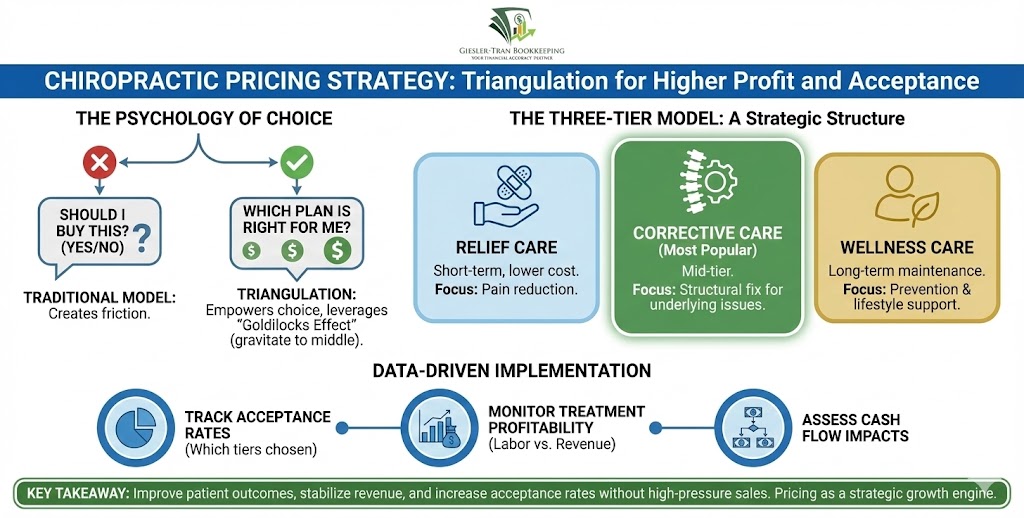
Chiropractic Pricing Strategy: Triangulation for Higher Profit and Acceptance
“Clinical skill isn’t the bottleneck — business structure is.”
The Reality Check: Fundamentally, most chiropractors are trained as clinicians, not CEOs. Consequently, many practices stay busy but barely profitable because they lack a deliberate chiropractic pricing strategy. Remember, triangulation shifts the patient’s mindset from “Should I buy?” to “Which plan fits me best?”, removing friction and building trust.
Listen on The Deep Dive — where we explore this topic further:
‘Triangulation Pricing and the Goldilocks Effect: How Triangulation Pricing Transforms Patient Acceptance’

Triangulation: The Psychology Behind Better Pricing Decisions
Initially, introducing multiple pricing tiers might seem complicated. However, in healthcare—especially chiropractic—triangulation simplifies the patient’s decision-making process. Specifically, instead of a single “take-it-or-leave-it” fee, you present three clearly defined care options. The purpose isn’t manipulation; the purpose is clarity.
When there is only one price, most patients compare it to doing nothing or “waiting and seeing.” In contrast, when patients see three options, they ask a different question: “Which plan best fits my goals, timeline, and budget?” That single shift improves acceptance, outcomes, and consistency without compromising ethics. Ultimately, a robust chiropractic pricing strategy aligns the patient’s financial commitment with their clinical needs.
The Three-Tier Chiropractic Model
Undoubtedly, to implement this effectively, you need clear definitions for each tier. Here is the standard model that successful practices use:
1. Relief Care — “Help me out of pain fast”
This tier focuses on short-term symptom reduction. It involves fewer visits and a lower financial commitment. While it solves the immediate problem, the goal is simply to relieve pain quickly.
2. Corrective Care — “Fix the underlying issue”
This tier addresses biomechanical problems so symptoms don’t return. It includes a structured treatment plan with rehabilitation and stabilization. Because it offers mid-tier pricing with strong value, most patients naturally gravitate here.
3. Wellness Care — “Stay well long-term”
Finally, this tier offers ongoing maintenance for patients committed to prevention. It features regular checkups and lifestyle coaching, providing the highest long-term value for both the patient and the practice.
Ask ChatGPT
Get an unbiased opinion!
Copy the prompt below to see what an AI behavioral economist suggests regarding pricing structures.
Why This Outperforms Fee-for-Service
Crucially, traditional fee-for-service models force a binary choice: “Do I want this or not?” However, triangulation reframes the decision to: “Which plan is right for me?” This subtle shift results in significantly higher acceptance rates and better alignment with patient goals. Moreover, it creates more predictable revenue and improves continuity of care. And because each tier is clinically justified, the process remains ethical and transparent.
Where Practices Struggle Without Data
Admittedly, a chiropractic pricing strategy only works when the math supports the business. Too often, chiropractors underprice their care plans or overdeliver in lower tiers without realizing it. Consequently, they end up working harder for less profit. Without tracking results, pricing becomes a gamble rather than a growth engine. That is where financial oversight becomes mission-critical.
To verify your current profitability, consider a Strategic Advantage review.
How Giesler-Tran Bookkeeping Turns Pricing Into Strategy
Our role isn’t to design care; our role is to make sure your pricing supports sustainable profit. At Giesler-Tran Bookkeeping, we help you track the metrics that matter. Specifically, we analyze:
- Acceptance Rates: We track how many patients choose Relief vs. Corrective vs. Wellness to identify trends.
- Treatment Profitability: We analyze labor costs, provider time, and overhead to reveal which plans generate true profit.
- Cash-Flow Modeling: We test prepaid plans and memberships to prevent financial surprises before you implement changes.
Q&A: Implementing Triangulation Pricing
Q: Won’t patients just choose the cheapest option?
A: Surprisingly, no. Most patients want the “correct” solution, not the cheapest one. The Corrective Care tier is usually the most popular because it offers the best balance of value and results.
Q: Is this ethical?
A: Absolutely. You are providing full transparency and clinical justification for every option. Patients appreciate being given a choice rather than being sold a single, expensive package.
Q: How do I track which plan is most profitable?
A: By tagging revenue in your accounting software. We can set up specific income accounts for each tier to monitor performance in real-time.
Q: Can I change my prices later?
A: Yes, but you should do so strategically. Reviewing your profitability quarterly allows you to adjust fees based on data, not fear.
Q: Do insurance limitations affect this?
A: Yes, but triangulation works exceptionally well for cash-based or hybrid practices. For insurance-based clinics, the “Wellness” tier is often a cash-pay option for maintenance.
In Summary: Stop Guessing
Ultimately, if your books don’t clearly show which plans convert best, you are guessing. By implementing a data-driven chiropractic pricing strategy, you turn your numbers into a competitive advantage. If you are ready to stop grinding and start growing, let’s talk.
The Bottom Line
Turn pricing into a profit engine.
Build a practice that thrives.
Schedule a Complimentary Practice Review

Proudly supporting entrepreneurs and organizations from Camas, WA and Vancouver, WA to Portland, OR, Washougal, WA, and throughout Seattle, Los Angeles, San Francisco, San Diego, Phoenix, Denver, Dallas, Houston, Chicago, Miami, Atlanta, Boston, New York, Philadelphia, and every community in between. Wherever your business calls home—across the Pacific Northwest, the West Coast, or anywhere nationwide—Giesler-Tran Bookkeeping delivers expert financial clarity and trusted service in all 50 states.
This content is for educational purposes only and not intended as tax, legal, or financial advice. Consult a qualified professional for guidance specific to your business.
One Response