
Historically, many small business owners treat their bookkeeping as a compliance chore—something to be endured once a year to keep the IRS happy. Consequently, they only see their Profit & Loss statement when their accountant hands it to them in March. By then, the data is 14 months old and useless for decision-making. However, high-growth companies operate differently. They rely on accurate monthly financial statements to navigate the present, not just record the past. At Giesler-Tran Bookkeeping (GTB), we believe your financial reports should be a windshield, not a rearview mirror. Therefore, this guide explores how shifting to a monthly reporting cadence can transform your business from reactive to proactive.
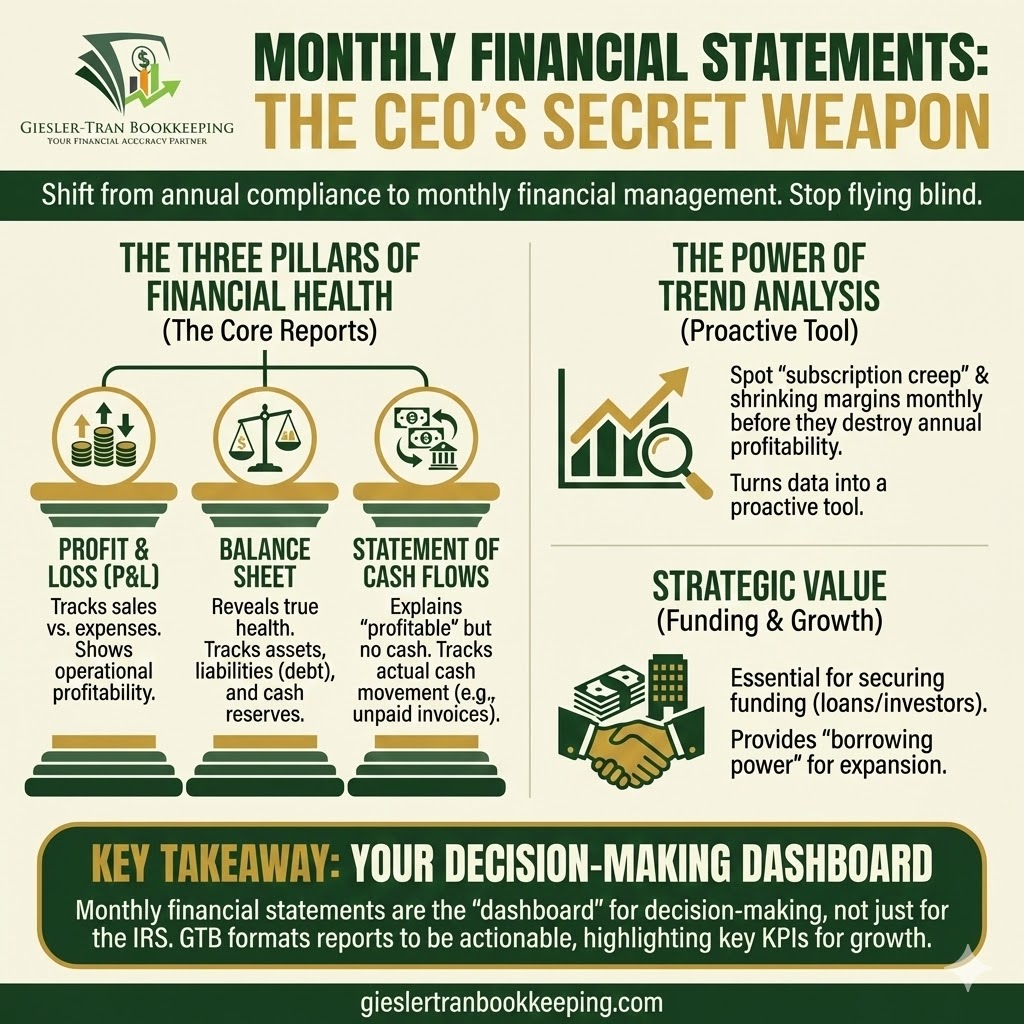
Monthly Financial Statements: The CEO’s Secret Weapon
Why Waiting Until Year-End Cost You Money
The Reality Check: Fundamentally, running a business without monthly financial statements is like driving a car with your eyes closed, opening them only once every 100 miles to see where you ended up. You might still be on the road, or you might be in a ditch. If you don’t know your gross margin, operating expense ratio, or net profit *this month*, you cannot fix problems before they become disasters. Real control comes from real-time data.
Listen on The Deep Dive — where we interpret the numbers:
‘Reading the Map: Monthly Reports Are Your Financial Windshield’

The Three Pillars of Your Monthly Financial Statements
Often, entrepreneurs focus solely on the “Bottom Line” (Net Income). While important, it is only one part of the story. Effective management requires analyzing the three core reports included in your monthly financial statements package.
- The Profit & Loss (Income Statement): This tells you if you are making money on your core operations. It reveals trends in sales vs. expenses over time.
- The Balance Sheet: This shows your financial health—what you own (assets) vs. what you owe (liabilities). Crucially, it tracks your cash reserves and debt load.
- The Statement of Cash Flows: Often ignored, this report explains why you can show a profit but still have no money in the bank (e.g., stuck in inventory or unpaid invoices).
Together, these three documents form the “vital signs” of your business. Reviewing them monthly allows you to pivot quickly. See Investopedia’s breakdown of these statements for a deeper technical dive.
Spotting Trends Before They Become Traps
Specifically, the power of monthly reporting lies in trend analysis. If you only look at numbers annually, a spike in software costs looks like a blip. However, with monthly financial statements, you might notice that your subscription costs have crept up 5% every month for six months. This is “subscription creep,” and it kills profitability silently.
Similarly, tracking your Gross Profit Margin monthly helps you spot pricing issues immediately. If your costs of goods sold (COGS) rise but your prices stay the same, your margin shrinks. Catching this in February allows you to adjust prices in March, saving the year. Waiting until December means you simply lost money for 10 months. Check our Strategic Advantage page to see how we help clients interpret these trends.
Ask ChatGPT
Get an unbiased opinion!
Copy the prompt below to learn how to analyze your own reports.
Using Monthly Financial Statements to Secure Funding
Eventually, you may need capital to expand—whether it’s a line of credit, an SBA loan, or an investor. When that day comes, the first thing they will ask for is your year-to-date monthly financial statements. If you hand them a mess or say “my CPA is working on it,” the conversation is over.
In contrast, presenting crisp, reconciled monthly reports signals competence and risk management. Banks love predictability. Showing that you review your numbers monthly proves you are a responsible steward of capital. Therefore, maintaining these reports is not just about tax; it is about “borrowing power.”
From Data to Decisions: The GTB Approach
Unfortunately, data without context is just noise. That is why GTB doesn’t just email you a PDF and disappear. We format your monthly financial statements to be readable, highlighting key KPIs (Key Performance Indicators) relevant to your industry.
For example, for a medical practice, we might track “Revenue per Provider.” For a construction firm, we track “Job Profitability.” We help you translate the accounting jargon into business English. Learn more about our industry-specific expertise in our Hidden Bill post.
Q&A: Mastering Your Monthly Reports
Q: When should I receive my monthly statements?
A: Ideally, by the 15th of the following month. This ensures the data is fresh enough to act upon.
Q: What if I don’t understand the Balance Sheet?
A: That is normal. We provide a video overview or a brief summary call to explain what the numbers mean for your cash position.
Q: Can I customize these reports?
A: Yes. QuickBooks allows us to tag transactions by location, class, or project, giving you granular detail.
Q: Why is my profit different from my bank balance?
A: Timing. Profit includes sent invoices you haven’t been paid for yet (Accrual basis) or excludes loan principal payments. We help you reconcile the difference.
Q: Is this included in the fixed price?
A: Absolutely. Monthly reporting is the core deliverable of our service packages.
Key Takeaways
- Proactive Management: Monthly financial statements allow you to steer the ship, not just watch the wake.
- Trend Analysis: Spotting small leaks in spending monthly saves thousands annually.
- Funding Readiness: Banks require up-to-date reports; being ready speeds up loan approvals.
- Peace of Mind: Knowing exactly where you stand every 30 days eliminates financial anxiety.
In Summary: Knowledge is Profit
Ultimately, the difference between a struggling business and a scaling one often comes down to financial visibility. Stop flying blind. Start using your monthly financial statements as the strategic tool they were meant to be. At Giesler-Tran Bookkeeping, we ensure you have the data you need to win. Don’t guess—know.
The Bottom Line
Accurate data. Smarter decisions.
Get your financial roadmap today.

Proudly supporting entrepreneurs and organizations from Camas, WA and Vancouver, WA to Portland, OR, Washougal, WA, and throughout Seattle, Los Angeles, San Francisco, San Diego, Phoenix, Denver, Dallas, Houston, Chicago, Miami, Atlanta, Boston, New York, Philadelphia, and every community in between. Wherever your business calls home—across the Pacific Northwest, the West Coast, or anywhere nationwide—Giesler-Tran Bookkeeping delivers expert financial clarity and trusted service in all 50 states.
This content is for educational purposes only and not intended as tax, legal, or financial advice. Consult a qualified professional for guidance specific to your business.
One Response