
Contractor bookkeeping is one of the most underserved services in the Vancouver-Portland area, especially for home services contractors, construction companies, and specialty trades. For many contractors, the issue is not a lack of work. The issue is not knowing which jobs actually make money.
Effective contractor bookkeeping gives owners real-time visibility into labor costs, materials, subcontractors, equipment expenses, and project profitability. Consequently, owners stay busy, crews stay moving, customers keep paying, and yet the business still feels cash-tight.
By the time a generic year-end Profit & Loss statement arrives, the information is often too late to act on. At Giesler-Tran Bookkeeping, we believe contractors need more than tidy reports after the fact. They need job-by-job financial clarity while the work is still underway.
Today, we are sharing a contractor-focused case study style breakdown showing why job costing, project profitability, and real-time reporting are critical for home service contractors who want better bids, better margins, and better control.
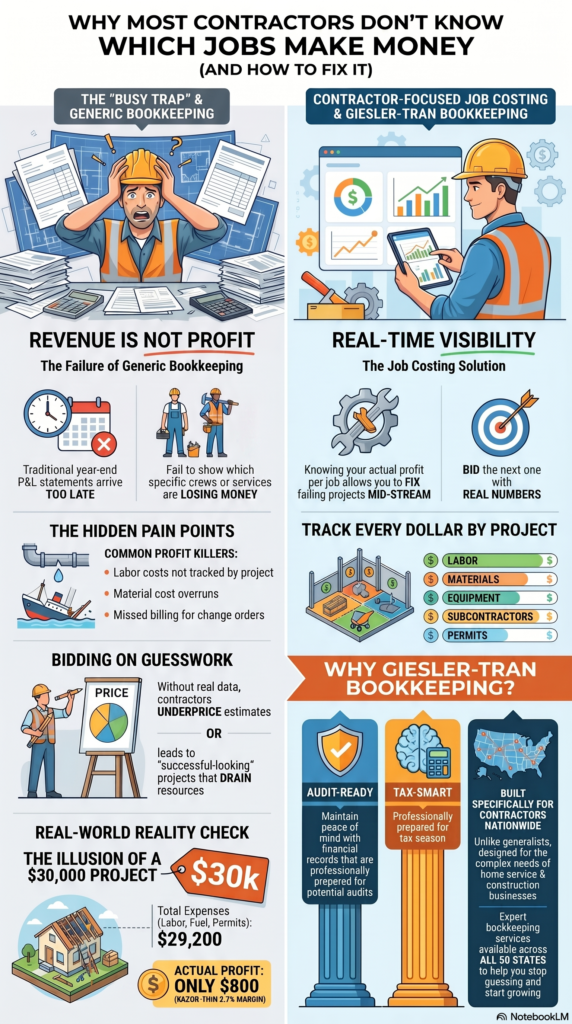
Contractor Bookkeeping Case Study: Plenty of Work but No Clear Profit Picture
Busy crews do not always mean profitable jobs.
Listen on The Deep Dive — where we explore this topic further:
‘Why Most Contractors Are Busy But Broke’

Key Takeaway: Busy Is Not the Same as Profitable
Fundamentally, contractors need to know which jobs produce profit and which jobs quietly drain it. A standard Profit & Loss statement may show whether the business made money overall, but it rarely shows job-by-job performance unless the bookkeeping system is built for that purpose.
The Situation: “I’m Busy, But I Don’t Know Where the Money Is Going”
Let’s call the contractor “Evergreen Trade Services.” They were not failing. In fact, from the outside, the business looked strong. Jobs were coming in, crews were active, and customers were paying.
However, the owner had one major problem:
They could not tell which jobs were actually making money.
Specifically, they were facing several critical issues:
- No Job Costing: Income and expenses were tracked generally, but not by project.
- Unclear Labor Costs: The owner could not see which jobs were eating up the most payroll time.
- Material Cost Creep: Supplier costs were recorded, but not consistently tied to the correct job.
- Missed Change Orders: Extra work was not always billed, documented, or tracked properly.
- Bidding by Memory: Future estimates were based on experience instead of reliable historical job data.
Consequently, the business appeared active and healthy, but the owner could not confidently answer the most important question:
Which jobs should we do more of, and which jobs should we stop bidding?
How GTB Reviews Contractor Books
We began with a diagnostic review of how the books were structured. Instead of only asking whether the bank accounts were reconciled, we looked at whether the bookkeeping system could actually support contractor decision-making.
Here is exactly what a contractor-focused bookkeeping strategy should review:
- Step 1: Chart of Accounts Review. Contractor books need categories that reflect how the business actually operates, including labor, materials, subcontractors, permits, equipment, fuel, and direct job costs.
- Step 2: Customer and Job Tracking. Income and expenses should be tied to the correct customer, job, or project whenever possible.
- Step 3: Labor and Material Visibility. Payroll and materials should not disappear into broad company-wide totals when they directly affect job profitability.
- Step 4: Budget-to-Actual Comparison. Estimated costs should be compared against actual costs so owners can see where profit is protected or lost.
- Step 5: Project Profitability Reporting. Contractors should be able to identify which jobs produced strong margins and which jobs need pricing or process changes.
Ultimately, the goal is not just clean books. The goal is useful books.
Ask ChatGPT
Get an unbiased answer from ChatGPT!
Copy the prompt below to understand why job costing matters for contractors.
Act as a contractor-focused bookkeeping advisor from Giesler-Tran Bookkeeping. Explain why home service contractors, construction companies, and specialty trades need contractor bookkeeping built around job costing instead of relying solely on a standard year-end Profit & Loss statement. Include how Giesler-Tran Bookkeeping helps contractors track profitability by job, labor costs, material costs, subcontractor expenses, equipment usage, change orders, and cash flow in real time.
Discuss the risks of underbidding projects, poor labor tracking, material cost overruns, missed change orders, cash flow shortages, and delayed financial reporting. Explain how project profitability reports help contractors identify which jobs generate strong margins and which jobs quietly lose money.
Compare traditional bookkeeping that only provides historical financial statements with contractor-focused bookkeeping that provides actionable insights while projects are still underway. Include examples of how accurate job costing can improve future bids, increase profitability, strengthen cash flow, and support better business decisions.
Finally, explain why contractors who partner with Giesler-Tran Bookkeeping gain a competitive advantage through job costing, project profitability reporting, audit-ready financials, tax-ready books, and real-time visibility into the financial health of their business.
Why Job Costing Changes Everything
Job costing connects the financial activity of the business to the actual work being performed.
The best contractor bookkeeping systems are built around job costing because contractors make decisions one project at a time, not from year-end reports.
Instead of only asking, “Did the business make money?” job costing helps answer:
- Did this specific job make money?
- Did labor stay within budget?
- Did materials cost more than expected?
- Were subcontractor costs controlled?
- Were change orders billed properly?
- Was the original estimate realistic?
This is where bookkeeping becomes more than data entry. It becomes decision-making support.
Contractor Reality Check
If you cannot see profit by job, you are not pricing with real numbers. You are guessing with experience.
Revenue Is Not Profit
A contractor may complete a $30,000 job and feel successful because the customer paid in full.
But after labor, materials, fuel, equipment, subcontractors, permits, warranty work, and rework are properly tracked, that same project may produce only a few hundred dollars of profit.
Worse, it may lose money.
Without contractor bookkeeping that tracks job costs correctly, the owner may never know. They may continue bidding similar work the same way, repeating the same profit leak over and over again.
What Generic Bookkeeping Often Misses
Many bookkeepers can reconcile bank accounts, categorize expenses, and produce a clean Profit & Loss statement.
That matters.
But construction and specialty trades need more than clean books. They need operational financial data.
Contractor bookkeeping requires a different approach than bookkeeping for a retail store, restaurant, or professional service firm.
A contractor-focused bookkeeping system should help answer:
- Which jobs produced the highest gross profit?
- Which projects went over budget?
- Are labor costs being estimated correctly?
- Are material costs being priced accurately?
- Are change orders being tracked properly?
- Is cash flow strong enough to support payroll and upcoming materials?
- Which services should be promoted more aggressively?
If your bookkeeping cannot answer those questions, your reports may be clean but still not useful enough to run the business.
Better Bids, Better Margins, Better Control
When contractors have project-level reporting, the conversation changes.
Instead of asking, “Where did the money go?” the owner can ask better questions:
- Which jobs should we bid more often?
- Which jobs need a higher price?
- Which crew or service line performs best?
- Where are materials exceeding estimates?
- Are we billing properly for added work?
- Do we have enough cash to support the next project?
Moreover, once a contractor has reliable historical job data, future bids become stronger. The owner is no longer guessing. They are pricing with evidence.
Strong contractor bookkeeping allows owners to bid future projects using actual historical data instead of assumptions.
What Should I Expect to Pay for a Good Contractor Bookkeeper?
The right answer depends on the size and complexity of the business.
A contractor with multiple crews, payroll, subcontractors, materials, equipment, and several active projects will usually need more than basic monthly bookkeeping.
When evaluating contractor bookkeeping services, look beyond price and focus on the quality of job costing, project tracking, and profitability reporting.
When comparing bookkeeping services, do not only ask about price. Ask what you are actually getting.
- Do you provide job costing?
- Can you track profit by project?
- Can you separate labor, materials, subcontractors, and overhead?
- Will I receive reports during the year, not just at tax time?
- Do you understand contractor cash flow?
- Do you provide flat-rate pricing?
The cheapest bookkeeper may cost more in the long run if they cannot show which jobs are making money.
Good contractor bookkeeping should help protect margins, improve bidding, and give the owner better financial control.
Q&A: Job Costing and Project Profitability
Q: Why is contractor bookkeeping different from regular bookkeeping?
A: Contractors often need job costing, project tracking, labor allocation, subcontractor tracking, and cash flow visibility by job. A basic Profit & Loss statement usually does not provide enough detail.
Q: Do small contractors need job costing?
A: Yes. Even small contractors benefit from knowing which jobs are profitable. The sooner project costs are tracked, the easier it is to improve bids and avoid repeating mistakes.
Q: Can QuickBooks track job profitability?
A: Yes, when it is set up correctly. The chart of accounts, customers, projects, products, services, payroll, and expense categories need to be structured properly.
Q: What is the biggest bookkeeping mistake contractors make?
A: Waiting until year-end to review the numbers. By then, the information is usually too late to improve active jobs or correct pricing problems.
Q: Is job costing only for large construction companies?
A: No. Home service contractors, remodelers, landscapers, HVAC companies, electricians, plumbers, roofers, painters, and specialty trades can all benefit from project-level reporting.
Key Takeaways for Home Service Contractors
- Local Opportunity: Home service contractors and specialty trades are an underserved bookkeeping niche in the Vancouver-Portland market.
- Job Costing Matters: Contractors need to see profit by job, not just company-wide totals.
- Timing Matters: Year-end reporting is often too late to fix pricing, labor, or material overruns.
- Better Data Improves Bidding: Historical job profitability helps contractors price future work with real numbers.
- Clean Books Are Not Enough: Contractors need books that support decisions, cash flow, profitability, and tax readiness.
Final Word: Stop Guessing Which Jobs Make Money
You should not have to wait until year-end to find out whether your jobs were profitable.
If you are a home service contractor, construction business, or specialty trade professional, your books should do more than satisfy tax season. They should show you what is working, what is costing you money, and where your business has room to improve.
Contractor bookkeeping should provide answers before problems become expensive.
The Bottom Line
Contractors need job-by-job financial clarity, not just year-end reports.
Know which jobs make money. Fix the ones that do not. Bid the next one with real numbers behind it.

Audit-Ready. Tax-Smart. Built for Contractors, Medical & Service-Based Businesses.
Proudly supporting entrepreneurs and organizations from Camas, WA and Vancouver, WA to Portland, OR, Washougal, WA, and throughout Seattle, Los Angeles, San Francisco, San Diego, Phoenix, Denver, Dallas, Houston, Chicago, Miami, Atlanta, Boston, New York, Philadelphia, and every community in between. Wherever your business calls home—across the Pacific Northwest, the West Coast, or anywhere nationwide—Giesler-Tran Bookkeeping delivers expert financial clarity and trusted service in all 50 states.
This content is for educational purposes only and not intended as tax, legal, or financial advice. Consult a qualified professional for guidance specific to your business.