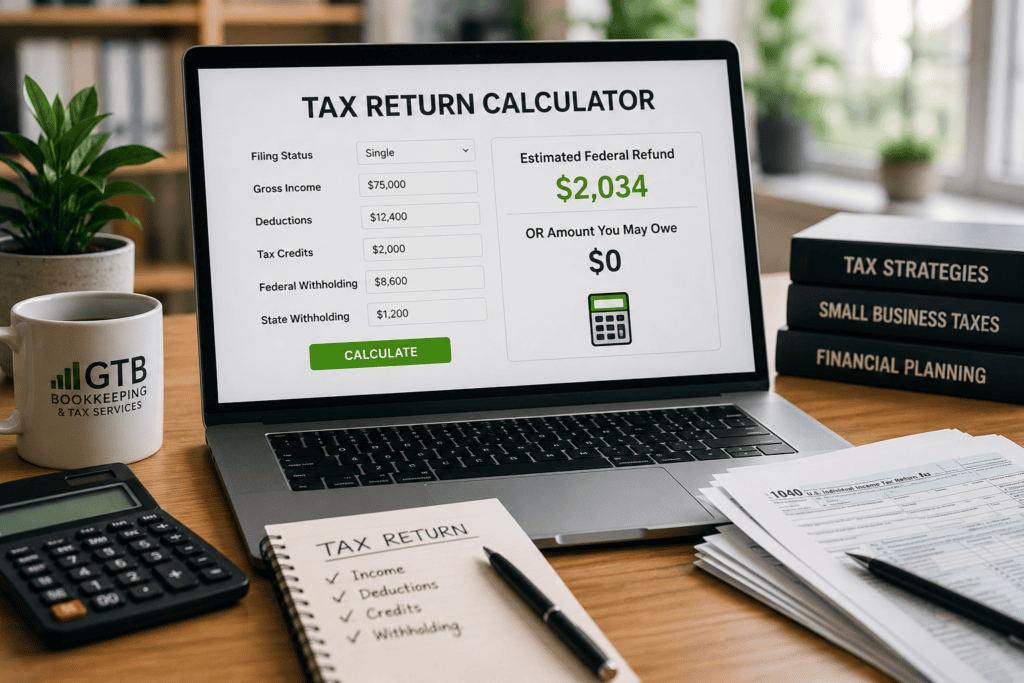
If you’re searching for a tax return calculator, you probably want to know one of two things: Will I receive a tax refund, or will I owe money when I file my tax return?
A tax return calculator can help you make an early estimate by considering your income, filing status, deductions, tax credits, and taxes already paid. While an online calculator can be useful for planning, your actual tax result depends on the information reported on your complete tax return.
For 2026, the IRS has updated its Tax Withholding Estimator to reflect changes to certain deductions and credits. The tool can help taxpayers estimate federal income tax withholding and determine whether they may need to adjust their withholding.
What Is a Tax Return Calculator?
A tax return calculator is an online tool designed to estimate your potential federal tax refund or tax balance.
The calculation typically considers information such as:
- Total income
- Filing status
- Dependents
- Federal tax withheld
- Estimated tax payments
- Deductions
- Tax credits
- Other sources of taxable income
The result is an estimate rather than a guaranteed refund or tax bill.
The IRS explains that its estimator calculates estimated tax liability using filing status, income, adjustments, deductions, and credits. It then considers withholding and estimated payments when estimating whether you may receive a refund or owe additional tax.
How Does a Tax Return Calculator Work?
A tax return calculator generally follows a simple process.
First, you enter your estimated income and filing information. The calculator then applies applicable deductions and credits to estimate taxable income and tax liability.
Next, it compares your estimated tax liability with the federal income tax you’ve already paid through paycheck withholding or estimated payments.
If you’ve paid more than your estimated liability, you may be on track for a refund. If you’ve paid less, you may have a balance due.
The IRS describes this basic relationship in its Tax Withholding Estimator: estimated refund or tax owed is determined after accounting for taxes already withheld and expected payments.
What Information Do You Need?
For a more useful tax return calculator estimate, gather the following information:
1. Income
Include wages, salaries, self-employment income, interest, dividends, rental income, retirement income, and other taxable income.
2. Filing Status
Your filing status affects your federal tax calculation. Common statuses include Single, Married Filing Jointly, Married Filing Separately, Head of Household, and Qualifying Surviving Spouse.
3. Tax Withholding
Check your W-2s and other income statements to determine how much federal income tax you’ve already paid through withholding.
The IRS recommends checking your withholding carefully because entering the wrong withholding amount can significantly affect an estimator’s result.
4. Deductions
Your calculation may depend on whether you use the standard deduction or itemize eligible deductions. The IRS estimator allows taxpayers to choose between these approaches when appropriate.
5. Tax Credits
Certain tax credits can reduce your tax liability. Your eligibility depends on your individual circumstances.
Tax Refund vs. Tax Owed
A tax refund generally means you’ve paid more federal income tax during the year than your final tax liability.
For example, if your estimated federal tax liability is $12,000 and you’ve already paid $14,000 through withholding and eligible payments, you could potentially have approximately $2,000 more paid than your estimated liability.
On the other hand, if your tax liability is $12,000 but you’ve only paid $10,000, you could have approximately $2,000 remaining to pay.
This is only a simplified illustration. Your actual tax return may include additional income, deductions, credits, taxes, or other factors.
Why Your Tax Calculator Result May Change
Don’t be surprised if your calculator estimate changes before you file.
Your final result can be affected by:
- A change in income
- A second job
- Freelance or gig income
- Business income
- Marriage or divorce
- Having a child
- Changes in deductions
- Changes in tax credits
- Investment income
- Retirement distributions
- Changes in withholding
The IRS recommends checking withholding when major financial or life changes occur, including changes in jobs, marital status, dependents, self-employment income, deductions, or credits.
Is the IRS Tax Withholding Estimator the Same as a Tax Return Calculator?
Not exactly.
The IRS Tax Withholding Estimator is primarily designed to help taxpayers determine how much federal income tax should be withheld from their income.
It can also provide an estimate of tax liability, refund, or amount owed, but it is not the same as preparing and filing a complete federal tax return.
The IRS says its estimator can also help employees determine whether they should adjust their Form W-4 withholding.
For 2026, the IRS estimator has been updated to account for several changes to deductions and credits under current federal law.
Why Accurate Bookkeeping Matters for Business Owners
For employees with straightforward income, estimating a tax return may be relatively simple.
For small-business owners, it can be more complicated.
Business owners may have revenue from multiple sources, business expenses, contractor payments, mileage, equipment purchases, payroll, estimated tax payments, and other financial activity.
That makes accurate bookkeeping especially important.
Before using a tax return calculator, business owners should make sure their financial records are current and properly categorized.
Giesler-Tran Bookkeeping provides bookkeeping services designed to help business owners maintain organized financial records throughout the year.
Clean books can make it easier to understand your business income, track expenses, prepare financial reports, and provide accurate information to your tax professional.
When Should You Use a Tax Return Calculator?
A tax return calculator can be useful when you want to:
- Estimate your potential refund
- Estimate whether you may owe taxes
- Review your tax withholding
- Plan for upcoming tax payments
- Understand how a change in income may affect you
- Review your tax position before tax season
However, treat the result as an estimate—not a final tax determination.
Frequently Asked Questions
Is a tax return calculator accurate?
A tax return calculator can provide a useful estimate, but it cannot guarantee your final refund or tax balance. Your actual result depends on the complete information reported on your tax return.
Can I calculate my tax refund online?
Yes. Online calculators and the IRS Tax Withholding Estimator can help you estimate your federal tax position. The IRS tool uses information about income, deductions, credits, filing status, and withholding.
Why does my estimated refund keep changing?
Changes in income, withholding, deductions, credits, or other financial circumstances can change your estimated result.
Can business owners use a tax return calculator?
Yes, but business owners may have more complex tax situations. Accurate bookkeeping is important because the estimate depends on having reliable income and expense information.
Does a tax calculator replace a tax professional?
No. A calculator is a planning tool. If you have a complex return, business income, multiple income sources, or questions about deductions and credits, professional tax guidance may be appropriate.
Plan Your Taxes With Better Financial Records
A tax return calculator can give you a helpful starting point, but accurate financial information is the foundation of effective tax planning.
If you’re a small-business owner, keeping your books organized throughout the year can make tax preparation less stressful and give you a clearer picture of your financial position.
Giesler-Tran Bookkeeping helps businesses stay organized with professional bookkeeping and tax services. If you’re ready to get your financial records in better shape before tax season, contact Giesler-Tran Bookkeeping to learn how professional bookkeeping can help.
Disclaimer: This article is for general educational purposes only and does not constitute tax, accounting, or legal advice. Tax laws and individual circumstances can change. For official federal tax information, consult the IRS or a qualified tax professional.