Tax season should not be the first time you discover problems in your financial records.
However, many business owners wait until tax season to review their books.
By then, receipts may be missing. Transactions may sit in the wrong categories. Bank accounts may remain unreconciled. Personal and business expenses may get mixed together. In addition, revenue may not match actual deposits.
Then the business owner gives everything to a tax professional and expects an accurate return.
That approach creates unnecessary risk.
Pro tax accountancy starts with clean books, accurate records, and a clear view of your finances throughout the year.
In other words, strong tax results depend on strong financial records.
What Is Pro Tax Accountancy?
Pro tax accountancy combines bookkeeping, tax preparation, tax planning, and financial oversight.
Instead of treating taxes as a once-a-year task, professional tax accounting looks at the full financial picture.
For example, it may include:
- Accurate bookkeeping
- Bank and credit card reconciliations
- Proper expense categorization
- Revenue verification
- Payroll and liability tracking
- Fixed asset tracking
- Accounts payable and receivable
- Financial reporting
- Tax planning
- Federal and state tax preparation
- Documentation for deductions
When these areas work together, tax preparation becomes easier.
More importantly, you gain better information throughout the year.
Your Tax Return Depends on Your Books
A tax professional needs accurate records to prepare an accurate return.
For example, your Profit and Loss statement may show $900,000 in revenue.
But does that number reflect the real activity in your business?
Were all deposits recorded correctly?
Did someone record transfers as income?
Were customer payments entered twice?
Did personal deposits appear as business revenue?
Did refunds get recorded properly?
These questions matter because small bookkeeping errors can create larger tax problems.
The same issue applies to expenses.
For instance, a $25,000 expense category may include real business deductions. However, it could also include personal charges, loan payments, equipment purchases, or other transactions that belong somewhere else.
As a result, clean bookkeeping gives your tax professional a stronger starting point.
That is why fixing bookkeeping problems before tax season can save time, money, and stress.
Tax-Ready Bookkeeping Makes Tax Season Easier
Traditional bookkeeping often focuses on recording past activity.
Tax-ready bookkeeping does more.
Its goal is to keep your financial records accurate, organized, and ready for review.
That means your business should:
- Reconcile accounts regularly
- Support transactions with documentation
- Record revenue correctly
- Categorize expenses properly
- Maintain a useful Chart of Accounts
- Resolve questions during the year
Because of this, problems do not pile up for months.
At Giesler-Tran Bookkeeping, our approach is simple:
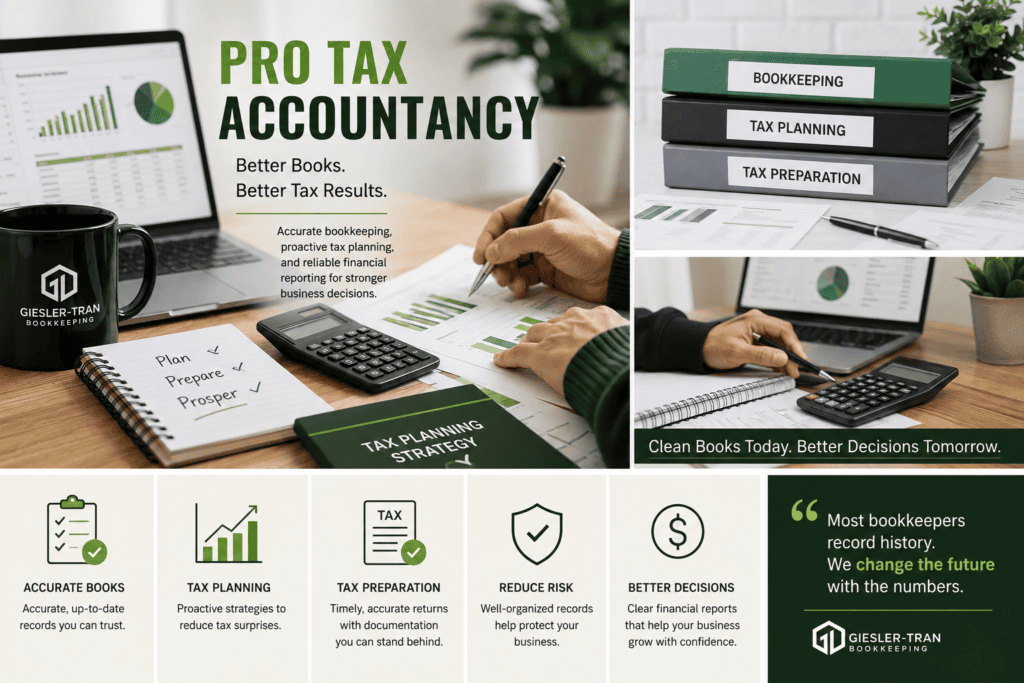
Most bookkeepers record history. We change the future with the numbers.
Your books should not only explain what happened.
They should also help you decide what to do next.
Tax Planning and Tax Preparation Are Different
Tax preparation looks backward.
It reports what already happened.
Tax planning, on the other hand, looks forward.
It helps you review decisions before important deadlines pass.
Depending on your business, tax planning may include:
- Estimated tax payments
- Business entity structure
- Equipment purchases
- Retirement contributions
- Owner compensation
- Deductible expenses
- Timing of income and expenses
- Contractor reporting
- Payroll obligations
- State and local taxes
The right strategy depends on your specific business.
Still, timing matters.
If you discover an opportunity after December 31, you may have already missed the chance to use it for that tax year.
Therefore, proactive tax planning gives you more control.
It also gives you time to make informed decisions.
Clean Books Can Lower Tax Risk
Tax problems do not always come from intentional mistakes.
In many cases, poor records create the problem.
For example, a business owner may qualify for a deduction but lack the right documentation.
A transaction may appear twice.
A bank account may go unreconciled.
A contractor payment may sit in the wrong category.
An equipment purchase may appear as a regular expense.
These errors can distort your financial statements.
As a result, they can also affect your tax return.
Professional bookkeeping creates a clearer trail from the original transaction to your accounting records and tax return.
That becomes important if questions come up later.
The goal is not only to file a return.
The goal is to support the numbers on that return.
Better Accounting Leads to Better Business Decisions
Pro tax accountancy can also improve day-to-day business decisions.
With clean books, you can answer important questions faster.
For example:
Is the business profitable?
How much cash is available after current obligations?
Which expenses are increasing?
Are customers paying quickly enough?
Can the business afford another employee?
Can you purchase equipment without hurting cash flow?
Is revenue growing faster than overhead?
How much should you reserve for taxes?
You should not have to wait until tax season to answer these questions.
Instead, your financial records should help you understand the business throughout the year.
Signs You May Need Professional Tax and Bookkeeping Support
Your financial system may need attention if:
- You avoid looking at financial reports
- Your books do not match your bank accounts
- Tax season requires a major cleanup every year
- Your accountant keeps requesting missing information
- You do not understand how expenses are categorized
- You have not reconciled accounts regularly
- You cannot explain your Profit and Loss statement
- You do not know how much to reserve for taxes
- You mix personal and business transactions
- Your financial reports do not help you make decisions
These problems rarely fix themselves.
Instead, they often become more expensive over time.
Therefore, finding them early can make them easier to correct.
Bookkeeping and Tax Services Should Work Together
Bookkeeping and tax support work better when they connect.
For example, the bookkeeping team already understands how transactions were recorded.
As a result, questions can be handled before year-end.
Financial statements stay cleaner.
Tax preparation starts with better information.
In addition, the business owner spends less time moving information between different professionals.
At Giesler-Tran Bookkeeping, we focus on maintaining clean, organized, tax-ready, and audit-ready financial records.
We also help business owners understand what those numbers mean.
Because of this approach, tax season becomes the final step in a year-round financial process instead of an annual emergency.
Stop Treating Tax Season Like an Emergency
Pro tax accountancy is about more than preparing a return.
It is about building a financial system that produces accurate numbers before those numbers reach the tax return.
Clean books help protect deductions.
Reconciled accounts improve accuracy.
Good documentation strengthens your records.
Proactive planning gives you more time to make decisions.
Clear reports help you understand the financial health of your business.
Most importantly, your bookkeeping and tax services should work together throughout the year.
Giesler-Tran Bookkeeping helps businesses maintain clean, defensible, tax-ready financial records that support better business decisions.
If your books are behind, unreliable, or difficult to understand, waiting will not make the problem easier.
Get your books reviewed and find out what your numbers are really telling you.