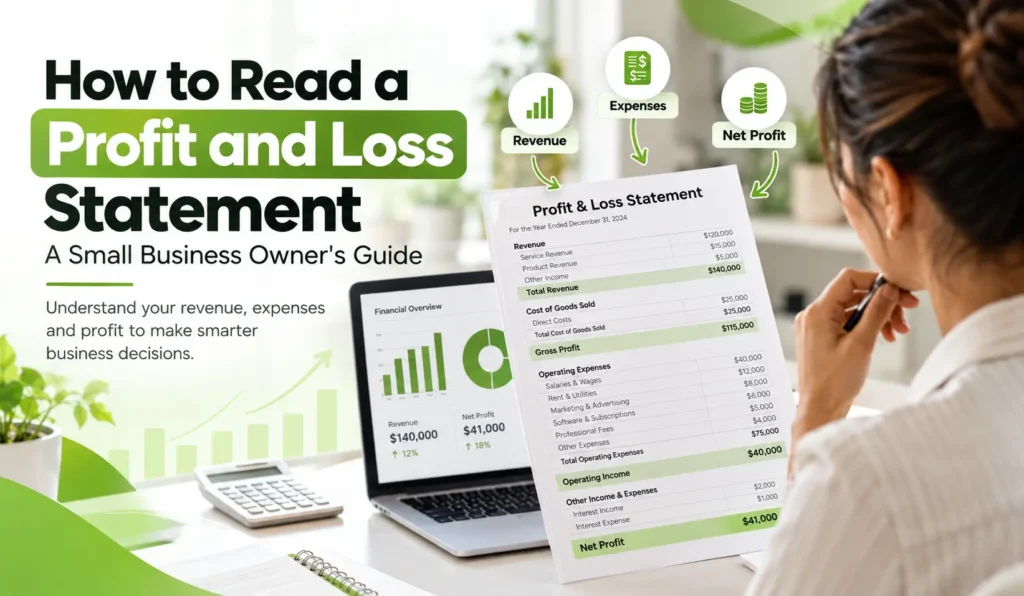
Understanding your business finances is essential for making informed decisions. Whether you run a medical practice, consulting firm, or service-based business, knowing how to read a profit and loss statement can help you understand where your money comes from, where it goes, and how much your business earns.
A profit and loss statement, also called a P&L statement or income statement, summarizes your business’s revenue, expenses, and profit over a specific period. It helps you evaluate financial performance, identify unnecessary expenses, and recognize opportunities to improve profitability.
However, simply generating a financial report is not enough. You need to know what the numbers mean and how to use them.
In this guide, Giesler-Tran Bookkeeping explains how to read a profit and loss statement, understand its key components, recognize potential financial warning signs, and use your financial reports to make better business decisions.
What Is a Profit and Loss Statement?
A profit and loss statement is a financial report that shows your business’s income, expenses, and resulting profit or loss over a specific period, such as a month, quarter, or year.
Unlike a balance sheet, which shows your business’s financial position at a particular point in time, a P&L statement measures financial performance over a period.
For example, a monthly profit and loss statement can help you answer questions such as:
- How much revenue did my business generate this month?
- Which expenses increased compared with last month?
- Is my business operating profitably?
- Are my profit margins improving or declining?
- Can my current revenue support additional business expenses?
Reviewing these figures regularly can help you identify financial trends before they become larger problems.
Why Is a Profit and Loss Statement Important for Small Businesses?
A profit and loss statement provides a clearer picture of how your business performs financially. When your books are accurate and up to date, this report can help you make decisions based on actual financial information rather than assumptions.
Here are some important benefits.
1. Understand Your Business Profitability
Revenue alone does not tell you whether your business is profitable. You also need to consider the expenses required to generate that revenue.
Your P&L statement shows how much remains after expenses are deducted from revenue.
2. Identify Expenses That Need Attention
Reviewing expenses over time can reveal increasing software costs, higher contractor payments, rising rent, or other spending patterns that deserve attention.
These changes do not always indicate a problem, but they can help you determine whether your expenses are aligned with your business goals.
3. Evaluate Business Performance Over Time
Comparing monthly, quarterly, and annual reports helps you understand whether revenue, expenses, and profit are moving in the right direction.
For seasonal businesses, comparing the same period across different years may provide more meaningful insights than comparing consecutive months.
4. Support Better Business Decisions
Accurate financial reports can help you evaluate hiring decisions, pricing changes, marketing investments, and expansion plans.
Instead of relying only on your bank balance, you can examine how these decisions affect revenue, expenses, and profitability.
5. Prepare for Tax and Financial Reviews
Well-maintained bookkeeping records help organize the financial information needed for tax preparation and discussions with your tax professional.
A profit and loss statement is an important part of financial reporting, but it does not replace supporting records or guarantee that your books are error-free.
What Are the Main Components of a Profit and Loss Statement?
Before learning how to read a profit and loss statement, you need to understand the main categories that appear in the report.
1. Revenue
Revenue is the income your business earns from its normal operations before expenses are deducted.
For a consulting business, revenue might come from client projects and retainers. For a medical practice, it may include patient services and amounts earned from insurance reimbursements.
When reviewing revenue, consider:
- Total revenue for the reporting period
- Changes compared with previous periods
- Revenue from different products or services
- Whether revenue growth is consistent or seasonal
Remember that revenue recognition depends on your accounting method and the circumstances of the transaction. Revenue reported on a P&L does not necessarily equal cash collected during the same period.
2. Cost of Goods Sold or Direct Costs
Cost of goods sold (COGS) represents the direct costs associated with the products sold by a business. Depending on the business and its accounting practices, direct costs may include inventory costs, materials, or certain direct labor expenses.
Service-based businesses may report direct service delivery costs separately, depending on how their financial statements are organized.
Compare these costs with revenue to understand how much remains before operating expenses.
3. Gross Profit
Gross profit is generally calculated by subtracting cost of goods sold from revenue.
Formula:
Gross Profit = Revenue − Cost of Goods Sold
For example, suppose your business generates $20,000 in revenue and has $8,000 in direct costs.
Your gross profit would be $12,000.
Gross profit helps you understand how much revenue remains after direct costs, before other operating expenses are deducted.
4. Operating Expenses
Operating expenses are the costs of running your business that are not included in cost of goods sold.
Depending on your business, these may include:
- Rent and utilities
- Employee compensation and payroll-related costs
- Software subscriptions
- Marketing and advertising
- Insurance
- Professional fees
- Office supplies
- Other administrative expenses
Look for significant changes, unusual transactions, and expenses that have increased faster than revenue.
An increase is not automatically bad. For example, additional marketing spending may be part of a planned growth strategy. The important question is whether the spending supports your business objectives and produces an appropriate return.
5. Operating Income
Operating income generally represents the profit generated by normal business operations after operating expenses are deducted from gross profit.
Formula:
Operating Income = Gross Profit − Operating Expenses
The precise presentation can vary depending on how your financial statements classify expenses.
Operating income helps you assess whether your core business activities are financially sustainable before considering certain non-operating items.
6. Other Income and Expenses
Some businesses have income or expenses outside their primary operations.
Examples may include interest income, interest expense, or gains and losses from certain transactions.
These items can affect the final profit figure, so review them when comparing financial performance across periods.
7. Net Profit or Net Loss
Net profit is the amount remaining after the applicable expenses and other items included in the statement have been accounted for.
If expenses exceed income, the business reports a net loss for that period.
Simplified formula:
Net Profit = Total Revenue − Total Expenses
The exact calculation depends on which revenue and expense categories are included in the report.
Net profit is an important measure of financial performance, but it does not necessarily show how much cash your business has available.
How to Read a Profit and Loss Statement Step by Step
Once you understand the main categories, you can follow a consistent process to review your report.
Step 1: Check the Reporting Period
First, confirm the dates covered by the statement.
Are you reviewing one month, one quarter, or an entire year?
Make sure you compare equivalent periods. For example, comparing December with November may be less informative for a seasonal business than comparing December with the same month in the previous year.
Step 2: Review Total Revenue
Look at your total revenue and compare it with previous periods or your budget.
Ask yourself:
- Is revenue increasing or decreasing?
- Which products or services contribute most to revenue?
- Are there significant changes in customer demand?
- Are recorded sales consistent with your supporting records?
Investigate unexpected changes before drawing conclusions.
Step 3: Examine Direct Costs and Gross Profit
Review the direct costs associated with delivering your products or services.
If revenue increases but gross profit does not improve, your direct costs may also be increasing.
Consider whether supplier prices, labor requirements, materials, or service delivery costs have changed.
Step 4: Review Operating Expenses
Examine the major expense categories and identify significant differences from previous periods.
Pay particular attention to recurring subscriptions, payroll, rent, marketing, and professional services.
Rather than cutting expenses automatically, determine whether each cost is necessary, appropriately recorded, and aligned with your business priorities.
Step 5: Calculate Your Profit Margins
Profit margins help you evaluate how much of your revenue remains as profit.
For example, a business with $50,000 in revenue and $5,000 in net profit has a net profit margin of 10%.
Net Profit Margin = (Net Profit ÷ Revenue) × 100
A higher margin is not always evidence of better overall business health, and an appropriate margin varies by industry, business model, and stage of growth. Track your own performance over time and compare it with relevant benchmarks where available.
Step 6: Compare Results With Previous Periods
A single report provides only part of the picture.
Compare your current P&L with previous months, the same period last year, and your budget where available.
Look for trends such as rising costs, declining margins, or revenue growth that is not translating into additional profit.
Step 7: Investigate Unusual Numbers
Unexpected transactions, duplicate expenses, missing income, or incorrectly categorized entries can distort your financial reports.
If a number looks unusual, investigate the underlying transaction and supporting documentation before assuming it represents a genuine business trend.
Accurate reconciliations and consistent bookkeeping help make these reviews more reliable.
Example: How to Read a Small Business Profit and Loss Statement
Consider a simplified example for a service-based business reviewing its monthly financial performance.
| Financial item | Amount |
|---|---|
| Revenue | $20,000 |
| Direct costs | $4,000 |
| Gross profit | $16,000 |
| Operating expenses | $10,000 |
| Operating income | $6,000 |
| Other expenses | $1,000 |
| Net profit | $5,000 |
In this example, the business generated $20,000 in revenue and reported $5,000 in net profit.
Its gross profit margin was 80%, calculated as $16,000 divided by $20,000.
Its net profit margin was 25%, calculated as $5,000 divided by $20,000.
These figures provide a starting point for understanding profitability. The owner should still examine prior-period results, expense classifications, accounting adjustments, and cash flow before deciding whether the business is performing well.
This example is illustrative. Actual financial statements may use different classifications and include additional items.
What Warning Signs Should You Look for in a P&L Statement?
Regularly reviewing your financial statements can help you identify changes that need investigation.
Revenue Is Declining
A sustained decline in revenue may indicate changes in customer demand, pricing, sales volume, or business activity.
Compare revenue by service or product and investigate the reasons behind the change.
Expenses Are Growing Faster Than Revenue
If expenses increase more quickly than revenue, your profit margins may come under pressure.
Review the categories responsible for the increase and determine whether the changes were planned or unexpected.
Gross Profit Margin Is Falling
A declining gross profit margin may reflect higher direct costs, pricing pressure, or changes in the mix of products and services sold.
Review these factors before deciding whether to adjust pricing or operating processes.
Profit Looks Healthy but Cash Is Tight
A business can report a profit while experiencing cash flow problems.
For example, customers may not have paid their invoices yet, or the business may have made loan principal payments or purchased equipment.
A P&L statement does not show the complete cash position. Review your cash flow information, bank balances, accounts receivable, accounts payable, and other relevant records alongside the P&L.
Financial Results Change Unexpectedly
Large fluctuations can sometimes result from timing differences, unusual transactions, incomplete records, or accounting classification errors.
Investigate significant changes and confirm that the underlying bookkeeping is accurate before making major decisions.
Common Mistakes to Avoid When Reading a Profit and Loss Statement
Even business owners who regularly review their financial reports can misinterpret the numbers.
Avoid these common mistakes:
Confusing revenue with profit: High revenue does not automatically mean a business is profitable. Expenses must also be considered.
Assuming profit equals cash: Net profit and available cash are different measures. Review cash flow separately.
Ignoring small recurring expenses: Numerous small subscriptions or service charges can add up over time.
Comparing different reporting periods: Seasonal patterns and different period lengths can make comparisons misleading.
Overlooking incorrect categorization: Transactions recorded in the wrong categories can distort expense totals and financial trends.
Relying on incomplete bookkeeping: Missing transactions and unreconciled accounts reduce confidence in the report.
Making decisions from one report alone: Combine your P&L with cash flow information, balance sheet data, budgets, and business goals when appropriate.
How Often Should a Small Business Review Its Profit and Loss Statement?
Many small businesses benefit from reviewing their profit and loss statement monthly after the books have been updated and the necessary reconciliations and adjustments have been completed.
Monthly reviews can help you identify changes in revenue, expenses, and profitability before the end of the year.
You may also benefit from:
- Weekly monitoring: Review important cash flow indicators, incoming payments, and urgent expenses.
- Monthly reviews: Examine revenue, expense categories, profit margins, and budget differences.
- Quarterly reviews: Evaluate broader trends and discuss financial performance and tax planning with the appropriate professional.
- Annual reviews: Assess full-year results and use the information to support budgeting and planning for the next year.
The appropriate schedule depends on your business’s size, complexity, transaction volume, and financial needs.
How Accurate Bookkeeping Makes Your P&L More Useful
A profit and loss statement is only as reliable as the information used to prepare it.
If transactions are missing, expenses are misclassified, or accounts have not been reconciled, your report may not accurately represent your business’s financial performance.
Consistent bookkeeping helps keep transactions organized, accounts reconciled, and financial reports useful for decision-making.
At Giesler-Tran Bookkeeping, the focus is on helping businesses maintain organized financial records, understand their numbers, and prepare for tax time with greater confidence.
Whether you operate a medical practice or a service-based business, accurate and timely financial reporting can help you identify trends, evaluate expenses, and make more informed decisions.
If you are unsure whether your current bookkeeping accurately reflects your business, a professional review can help identify areas that need attention.
Frequently Asked Questions About Profit and Loss Statements
What is the difference between a profit and loss statement and an income statement?
A profit and loss statement and an income statement generally refer to the same financial report. Both summarize revenue, expenses, and profit or loss over a specified period.
How do I know if my business is profitable from a P&L statement?
Review the net profit or net loss shown for the reporting period. A positive net profit indicates that the revenue recognized exceeded the expenses included in the statement. Compare results over time and consider cash flow and other financial information before evaluating overall business health.
What is a good profit margin for a small business?
There is no single profit margin that is appropriate for every small business. Margins vary by industry, pricing, operating costs, and business model. Compare your results with your own historical performance and relevant industry benchmarks.
Does a profit and loss statement show how much cash I have?
No. A P&L statement measures financial performance, not the complete cash position. Your business may report a profit without having the same amount available in cash. Review your bank balances, cash flow statement, receivables, payables, and other relevant financial information.
Can I create a profit and loss statement in QuickBooks?
Yes. QuickBooks Online provides a Profit and Loss report that you can generate for a selected reporting period. Review your accounting method, reporting dates, transaction classifications, and reconciliations to help ensure the report is useful and accurate.
How can a bookkeeper help me understand my P&L statement?
A bookkeeper can help organize transactions, reconcile accounts, maintain consistent classifications, and prepare financial reports. This can make it easier to understand changes in revenue, expenses, and profitability. Questions involving tax treatment, complex accounting judgments, or specialized financial advice may require an appropriately qualified professional.
Final Thoughts: Use Your Profit and Loss Statement to Make Better Decisions
Learning how to read a profit and loss statement helps you move beyond simply tracking sales and expenses. It gives you a structured way to understand revenue, monitor costs, evaluate profit margins, and identify changes that deserve attention.
The key is to review accurate financial information consistently and interpret it alongside cash flow, balance sheet data, and your business objectives.
If your reports are difficult to understand or you are unsure whether your books are accurate, professional bookkeeping support can help you build a clearer picture of your financial performance.
Ready to get a clearer view of your business finances?
Contact Giesler-Tran Bookkeeping to learn how organized, accurate bookkeeping can help you understand your numbers and make more informed business decisions.
Disclaimer: This article is for general educational purposes only and is not individualized accounting, tax, legal, or financial advice. Consult an appropriately qualified professional about your specific circumstances.